We need your help with a specific payment process on Acumatica. Here is our scenario:
An employee hires a worker and pays them on behalf of the company. Later, the employee submits the documents and bills to the company to get a reimbursement (get their money back).
Our desired process is:
The company receives the bill from the employee.
We create a Bill in Acumatica where the Vendor is the worker, and we apply withholding tax.
We pay the full amount to the employee, but the withholding tax must be recorded under the worker.
We tried using the Joint Payee feature on the Bill, but it did not work. It does not allow us to pay the full amount to the employee while keeping the withholding tax history for the worker.
Is there any way to handle this payment process in Acumatica?
Best answer by Laura03
Hello,
This is my understanding of your current process. I could have missed something since I don’t know how your tax is reported and paid.
Example: A person works 100 hours for $10 per hour. How much were they paid? I understood the Worker was paid full amount, $1000; no tax was withheld. Suppose withholding tax should have been $100 and payment to subcontract worker should have been $900 net.
Company reimburses the employee. How much do you reimburse the employee? I think Company reimburses employee for $1000 - representing amount they actually paid the worker - Withholding Tax + Net. At this point, worker was paid extra $100 and same $100 was reimbursed to employee - representing the first time your Company records $100 withholding tax payment - to your employee.
Later, Tax Agency requires payment of withholding tax. At end of month? - Company pays $100 to Tax Agency --> representing the second time Company has paid the same $100 tax.
I think best option is for Worker to invoice the company, and company withholds tax before paying the worker directly.
Now thinking about second work-around option that I suggested:
If Company enters an AP Bill to the worker - company wants to show as if tax was withheld. Enter $1000 Labor Expense debit, and - $100 Tax withheld on a separate line posting to Tax Withheld liability. This bill to the worker has correct tax but does not accurately represent the amount paid to the worker.
Company can use Employee Liability Cash Account to pay the $900 to the Worker, creating the Due To Employee credit and debiting Accounts Payable to the worker.
How much will the Company reimburse the Employee? $900 or $1000? If you reimburse he Employee $1000 this represents the first time Company is paying Tax amount $100 (paying to your employee).
Later, Company pays withholding tax again, to taxing authority.
One option is to set up the Employee-Payer as a liability Bank Account.
Enter Bill to the Worker with withholding tax applied. (Debit Labor, Credit AP)
Record a payment to the Worker’s Bill using Employee-Payer Bank Account (Debit AP, Credit employee liability Bank Account)
When Expense Report and receipts are received, Enter Bill to the Employee (Debit employee liability Bank Account, Credit AP)
Pay the Employee from a real Bank Account (Debit AP, Credit Cash)
This is similar to how we configure Employee credit cards - allowing the “real vendors” to show accurate history of what was paid, while reimbursing the employee when expense report and receipts are received at end of month.
One option is to set up the Employee-Payer as a liability Bank Account.
Enter Bill to the Worker with withholding tax applied. (Debit Labor, Credit AP)
Record a payment to the Worker’s Bill using Employee-Payer Bank Account (Debit AP, Credit employee liability Bank Account)
When Expense Report and receipts are received, Enter Bill to the Employee (Debit employee liability Bank Account, Credit AP)
Pay the Employee from a real Bank Account (Debit AP, Credit Cash)
This is similar to how we configure Employee credit cards - allowing the “real vendors” to show accurate history of what was paid, while reimbursing the employee when expense report and receipts are received at end of month.
Does that mean we need a temporary account for employee payment? Our users prefer not to use temporary accounts. What other options do we have available?
Because of withholding tax, I think the best option is you could ask the employee notto pay the workers directly; require the workers to submit their invoices to aP@YourCompany.com or require the Employee to turn over the Workers’ invoices to Accounting for payment. Then Company pays the workers directly. I think this is the best way to account for withholding tax.
An alternate solution is the 4 steps given above; paying workers from an Employee liability cash account allows payments to be entered in Acumatica to “the real vendors”. (This will work fine for 1099 workers in the US, for example, where the tax payment responsibility belongs to the subcontract employee at year-end.)
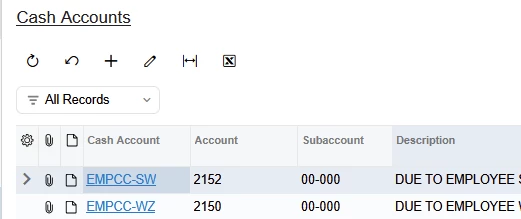
Second option requires no temporary account. If you want to allow the Employee to continue paying workers directly, one common solution is to the Employee is set up as a Bank Account in Acumatica,like this picture:
Due to Employee account set up as a Cash Acct; used to pay Vendor Bills
If you use the “Employee as Cash Account” option -
Employee pays workers. Employee pays other expenses like services, meals, fuel, travel.
Enter Bills (AP Cash Purchase screen) to the ‘real’ vendors - debits to an expense and credit Due to Employee cash account.
Enter bill/payment to Employee using a regular cash account. Debits due to employee & credits cash.
If the company pays the employee the Pre-tax amount for worker reimbursement, Company pays the withholding tax twice, as you know - to reimburse your employee and again to the government tax entity. Paying tax twice is to be avoided, obviously. However, the Employee Cash account works well for all other employee purchases where there is no withholding.
Because of withholding tax, I think the best option is you could ask the employee notto pay the workers directly; require the workers to submit their invoices to aP@YourCompany.com or require the Employee to turn over the Workers’ invoices to Accounting for payment. Then Company pays the workers directly. I think this is the best way to account for withholding tax.
An alternate solution is the 4 steps given above; paying workers from an Employee liability cash account allows payments to be entered in Acumatica to “the real vendors”. (This will work fine for 1099 workers in the US, for example, where the tax payment responsibility belongs to the subcontract employee at year-end.)
Second option requires no temporary account. If you want to allow the Employee to continue paying workers directly, one common solution is to the Employee is set up as a Bank Account in Acumatica, like this picture:
Due to Employee account set up as a Cash Acct; used to pay Vendor Bills
If you use the “Employee as Cash Account” option -
Employee pays workers. Employee pays other expenses like services, meals, fuel, travel.
Enter Bills (AP Cash Purchase screen) to the ‘real’ vendors - debits to an expense and credit Due to Employee cash account.
Enter bill/payment to Employee using a regular cash account. Debits due to employee & credits cash.
If the company pays the employee the Pre-tax amount for worker reimbursement, Company pays the withholding tax twice, as you know - to reimburse your employee and again to the government tax entity. Paying tax twice is to be avoided, obviously. However, the Employee Cash account works well for all other employee purchases where there is no withholding.
If we use the “Employee as Cash Account” option, will it record a duplicate expense? Because we are doing Bill & Payment for both Workers and Employees, and the withholding tax is only recorded in the tax account when the Bill is paid.
This is my understanding of your current process. I could have missed something since I don’t know how your tax is reported and paid.
Example: A person works 100 hours for $10 per hour. How much were they paid? I understood the Worker was paid full amount, $1000; no tax was withheld. Suppose withholding tax should have been $100 and payment to subcontract worker should have been $900 net.
Company reimburses the employee. How much do you reimburse the employee? I think Company reimburses employee for $1000 - representing amount they actually paid the worker - Withholding Tax + Net. At this point, worker was paid extra $100 and same $100 was reimbursed to employee - representing the first time your Company records $100 withholding tax payment - to your employee.
Later, Tax Agency requires payment of withholding tax. At end of month? - Company pays $100 to Tax Agency --> representing the second time Company has paid the same $100 tax.
I think best option is for Worker to invoice the company, and company withholds tax before paying the worker directly.
Now thinking about second work-around option that I suggested:
If Company enters an AP Bill to the worker - company wants to show as if tax was withheld. Enter $1000 Labor Expense debit, and - $100 Tax withheld on a separate line posting to Tax Withheld liability. This bill to the worker has correct tax but does not accurately represent the amount paid to the worker.
Company can use Employee Liability Cash Account to pay the $900 to the Worker, creating the Due To Employee credit and debiting Accounts Payable to the worker.
How much will the Company reimburse the Employee? $900 or $1000? If you reimburse he Employee $1000 this represents the first time Company is paying Tax amount $100 (paying to your employee).
Later, Company pays withholding tax again, to taxing authority.