Question

Disable scan serial number at picking

  • August 4, 2025
  • 6 replies
  • 142 views

Forum|alt.badge.img+1

Does anyone know if it’s possible to disable scanning of serial numbers during the picking process? Our client is also prompted to scan the serial numbers at the packing process, which is preferable, but it is duplicative work to also be required to scan during picking.

If not, does anyone have any workarounds or solutions? Ideally our client can still pick using scanners but just not be required to scan serial numbers at that time.


6 replies

Forum|alt.badge.img+9
  • Captain II
  • August 26, 2025

@michaelho 


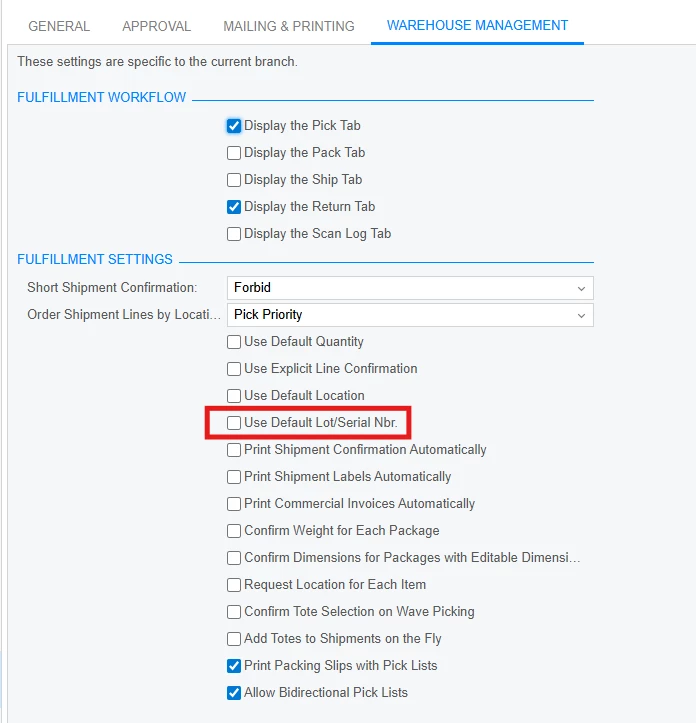
When you mark this field, it should skip it.


Forum|alt.badge.img+1
  • Author
  • Semi-Pro II
  • August 26, 2025

@aiwan I just tried that and it still prompted me to scan the serial number during the pick process.

And to clarify, in case it matters, these items are set to a lot/serial class with the Assignment Method = When Used.

Any other suggestions?


Forum|alt.badge.img+9
  • Captain II
  • August 27, 2025

@michaelho 


From what I have read, this could be why, because the system assigns the Lot/Serial nbr when the item is picked rather than when it is received into stock.


Forum|alt.badge.img+1
  • Author
  • Semi-Pro II
  • April 15, 2026

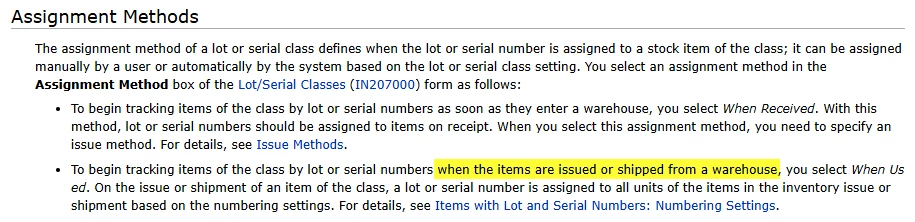
This seems like it might be a bug, based on the documentation:


If I’m reading the above correctly, the ‘When Used’ assignment method should only begin tracking these items when the items are issued or shipped from a warehouse. Picking items of this assignment method should not require tracking of serial numbers. Am I wrong about this?


This is a great question, and I can see why the behavior feels confusing based on the documentation.

What you’re experiencing is expected system behavior, not a bug. The key point is how Acumatica interprets “When Used.

In Acumatica, “When Used” means when the item is issued from inventory, not strictly when the shipment is confirmed. Within the Pick, Pack, Ship workflow, the Pick step is considered part of the inventory issue process, because this is where the system determines exactly which inventory (including specific serial numbers) is being allocated and removed from available stock.

Because of this, the system requires serial numbers to be assigned during picking. This ensures:

  • Accurate inventory tracking at the serial level
  • Proper allocation and availability validation
  • Prevention of duplicate or invalid serial usage

The Ship step then acts as a confirmation of what has already been issued, rather than the point where serials are first assigned.

That said, your use case is also valid. Some customers prefer to defer serial scanning to packing for operational efficiency, especially in high-volume environments. Unfortunately, as of now, there is no standard configuration to disable serial number scanning during picking while still requiring it during packing.

At this point, the available options are:

  • Customization to modify this behavior
  • Supporting the existing Community Idea ( ) to help drive product enhancement 

So, in short:
✅ Not a bug
✅ Working as designed
⚠️ But a legitimate gap for certain warehouse workflows


Hopefully this helps clarify things, and your scenario is definitely a strong candidate for future product improvement.


Forum|alt.badge.img+1
  • Author
  • Semi-Pro II
  • May 14, 2026

@WasanaWishmini21 this all makes perfect sense with the When Received assignment method since the serial numbers are assigned to an item upon receipt and ‘travel’ with the item through the system. But it makes much less sense for the When Used assignment method because scanning the serial numbers during picking has no benefit. It doesn’t update the actual lines of the Shipment with the serial numbers scanned, it doesn’t keep track of those serial numbers anywhere, and you have to scan them again during packing to actually save/store those numbers.

And yes - I created that Community Idea; hopefully some more community members vote for it so it has a better chance of being addressed.