Note: This response was generated with a help of an AI tool.
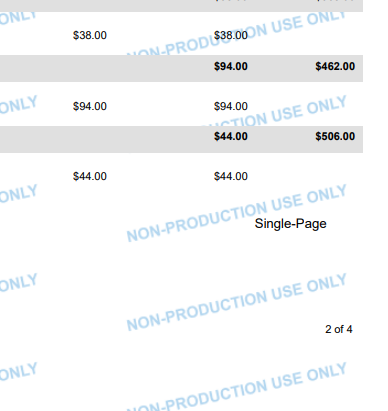
Yes, you can definitely achieve this by using the =PageOf() function in Acumatica, but with a clever combination of grouping or custom formulas in your report to differentiate between multi-page and single-page statements. Here’s how you can approach this:
Steps to Filter Multi-Page and Single-Page Statements:
-
Use the =PageOf() Function:
- The
=PageOf() function can be used to determine the total number of pages in each statement. It returns the current page number as well as the total number of pages (e.g., Page 1 of 3). - You can leverage this function to check whether a statement contains more than one page.
-
Create a Custom Formula:
- Create a custom calculated field in your report that uses the
=PageOf() function to detect whether a statement is a multi-page or single-page document. - For example, you can create a formula that checks if the total number of pages is greater than 1. Here's an example of how you could set this up:
plaintext
Copy code
=IIf(PageOf([StatementField]) > 1, "Multi-Page", "Single-Page")
- Replace
[StatementField] with the actual data field you are using to generate your statements.
-
Group the Report by Multi-Page and Single-Page:
- Once you have the custom formula to identify multi-page and single-page statements, you can use this field to group your report data.
- Group all multi-page statements first, followed by single-page statements. This allows you to easily separate and filter them based on the number of pages.
-
Sort or Filter the Data:
- Apply sorting to prioritize multi-page statements. If your report has multiple rows of data, you can sort the report based on the calculated field (the "Multi-Page" or "Single-Page" field).
- This way, you can either export or review the multi-page statements before moving on to the single-page statements.
Example Process:
-
In the Report Designer, add a calculated field to the detail section of the report:
- Formula:
=IIf(PageOf() > 1, "Multi-Page", "Single-Page")
-
Group the Report based on the calculated field (multi-page or single-page).
-
Sort the grouped data by the calculated field so that multi-page statements come first, and single-page statements follow.
Conclusion:
Using the =PageOf() function with a custom formula, you can group or filter the statements into multi-page and single-page categories. This will allow you to easily export, print, or send the statements based on the number of pages, and meet the requirements of the third-party printing service.